Holy Hash!

Security is quality under attack. Hard-won lessons in software security, from someone who built the programs and wrote the standards.

4 October

SHA-3 is there!

NIST has announced the end of the Secure Hash Algorithm competition the day before yesterday, naming Keccak as the winner and making it the SHA-3 algorithm. The complete announcement from NIST is here.

One thing of note is that since the algorithm was developed by STMicroelectronics and NXP Semiconductors, the algorithm is heavily optimized for the use in smart cards. According to the announcements, it is both compact and fast when implemented in hardware. Which makes it once again very well suited to some applications and difficult to use for others (like password hashing).

27 September

IEEE should be embarrassed

The world’s largest professional association for the advancement of technology” has been thoroughly embarrassed in an accident where they left their log files containing user names and passwords open for FTP access to all on the Net for more than a month, according to a DarkReading report. Or, at least, I think they should be embarrassed although they do not seem to be very.

The data for at least 100 000 members were exposed and IEEE took care to close the access. However, having access to the log files is not what I think they should be embarrassed about. As the things go, mistakes in configuration happen and files may become exposed. That’s just life.

However, what is really troublesome is that IEEE, the “world’s largest professional association for the advancement of technology” (according to themselves), has logged the usernames together with passwords in plaintext. I mean, we know that’s bad, and that’s been bad for at least a couple of decades. They are definitely at least a couple of decades behind on good security practices. I think that’s really embarrassing.

13 September

Random or not? That is the question!

Oftentimes, the first cryptography related question you come across while designing a system is the question of random numbers. We need some random numbers in many places when developing web applications: identifiers, tokens, passwords etc. all need to be somewhat unpredictable. The question is, how unpredictable should they be? In other words, what should be the quality of the random for those purposes?

It is very tempting (and is usually done this way) to make a single random number generator that is “sufficiently good” for everything and use it all over the place. That is a flawed approach. Yes, provided a true random number generator, this is feasible. But true random number generators are sparse and are usually unavailable in a web application. So you end up with a pseudo-random number generator of unknown quality that you re-use for multiple purposes. This last part matters because by observing random numbers used in one part of the system an attacker can deduce the random numbers used in another, totally hidden part of the system. What should one do?

Importantly, what is the value generated through a (pseudo-)random number generator going to be used for? Will the security of the whole system hang on this one value being totally unpredictable?

Generally, the system should not fall apart when a random value is suddenly not-so-random. The principles of layered security should prevent attacks even when they succeed to guess your random ids, tokens and so on.
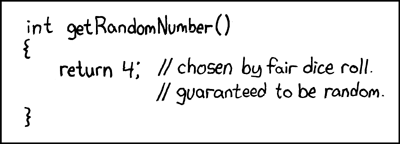
Random number generator by xkcd

Case in point: at Citibank they relied on the account numbers being “hidden”. They were not random to begin with and there was no other security in place, so anyone knowing the account number structure could go and receive information of other accounts in the bank. That kind of thing should not happen. When you use random values for ids of the information in your database, that’s good. But the security must not rely on just the ids. There must be some controls that prevent someone from seeing what they should not even when the ids are known.

Another case on the opposite side is the credit card “chip and pin” system, created by the EMV. They decided for some reason that it would be okay to have a random that is not, well, so random. The manufacturers, of course, decided to take the advantage and not provide the real random number generators. The criminal organizations, of course, took notice and promptly implemented card copying targeting the weak ATM terminals. All of this is because of a weak random. Which should not have happened because they were supposed to know that their security depends on that random number and they should have taken care. This is the case when you really need a proper random number generator and I am surprised MasterCard CAST actually let it be. But enough of the scary stories.

Generally, most of the times when you think”I need random numbers” you usually don’t. What you need are reasonably unpredictable numbers of fairly low cryptographic quality. And this is so because your system design must not be dependent on the quality of those random numbers. If it is, it is a bad design decision. Typically, whenever you encounter such a dependency you must consider a redesign. There are very few exceptions like key generation and similar things which you should not do yourself in the application code anyway. For the rest, the system must be fully operational and disallow access properly even if your random numbers are all equal to five suddenly. The system may fail to operate but it must not become wide open because of a failure of the random number generator.

There are situations where you could say that the security of the whole system relies on the random properties of a value. For example, the password reset systems of most websites send a random token by e-mail to the account holder. When this token is entered into the password reset page field, the system allows changing the password. If this token can be guessed (or forced to a particular value), the system’s security is easily compromised – just request the password reset and go enter the value, you do not need to see the e-mail. In this case, yes, that value must be truly random or at the very least impossible to predict with a reasonable period of time (your tokens do limit the “reasonable time” with a validity period assigned, right? Right??). Interestingly, in this case the delivery channel does not matter at all. Even if you had the so-called “two-factor” authentication system where you get this code sent by a short message to your mobile, it won’t matter. If an attacker can guess the token – the rest of the system is of no consequence in this design.

So, a typical system should have at least two random number generators. One used for internal purposes and one used to generate tokens sent to users. They should be good, both of them, but the one for tokens should be cryptographically strong while the one for internal use may be just fairly unpredictable because your security would not rely solely on those numbers. The generators should be written by people with some knowledge of cryptography, publicly reviewed and tested.

And here is some random reading for more on the subject:

  1. Randomness attacks against PHP applications.
  2. Chip and pin ‘weakness’ exposed by Cambridge researchers.
  3. Citigroup hack exploited easy-to-detect web flaw.
  4. How to test a random number generator.
  5. NIST on random number generators.
21 August

Car software security

I stumbled across an article on car software viruses. I did not see anything unexpected really. The experts “hope” to get it all fixed before the word gets out and things start getting messy. Which tells us that things are in a pretty bad shape right now. The funny thing is though that the academic group that did the research into vehicle software security was disbanded after working for two years and publishing a couple of damning papers, demonstrating that “the virus can simultaneously shut off the car’s lights, lock its doors, kill the engine and release or slam on the brakes.” An interesting side note is that the car’s system is available to “remotely eavesdrop on conversations inside cars, a technique that could be of use to corporate and government spies.” This goes in stark contrast to what car manufactures are willing to disclose: “I won’t say it’s impossible to hack, but it’s pretty close,” said Toyota spokesman John Hanson. Basically, all you can hope for is that they are “working hard to develop specifications which will reduce that risk in the vehicle area.” I don’t know, mate, I think I better stay with the good old trustworthy mechanic stuff. I guess I know too much about software security for my own good. I kinda feel they will be inevitably hacked. Scared? If there is a manual override for everything – not so much but… The second-hand car market suddenly starts looking very appealing by comparison…

10 August

NFC, ain’t that funny

N-Mark Logo for certified devices

When we invented NFC (Near Field Communication) we never intended it for some of the uses that it was put to afterwards. And when we started discussing those unconventional (for us) uses, we immediately pointed out all security problems and proposed methods to protect the NFC devices from various attacks. That was… probably 2004. Do you think anyone listened? Nope. After that, we put in a few years worth of work into some (ok, granted, fairly fuzzy for political reasons) guidance, standards and white papers in Ecma International and NFC Forum. Did anyone take notice? I don’t think so.

At the recent Black Hat security conference security researcher Charlie Miller detailed and demonstrated attacks to the NFC devices and showed how he can pown a mobile phone through a combination of NFC and browser attacks.

The reason? NFC is a new attack surface and it has to be protected, both by itself and in comnbination with all the other things that are operating in the same device. However, the usual thing has happened. People paid attention only to the hype of usefulness and ease of use of the technology but never paid attention to the security of it. Now the security will have to be added, again, as an afterthought.

Duh, the humanity.

10 August

Google on privacy

Google 貼牌冰箱(Google Refrigerator)

Google has been fined $22.5 million for breaching its privacy commitment and bypassing Apple’s Safari users security settings. As the article in Mercury News comments, citing Consumer Watchdog, “the commission has allowed Google to buy its way out of trouble for an amount that probably is less than the company spends on lunches for its employees and with no admission it did anything wrong.”

The days of when the motto of Google “do no harm” could be taken literally are long gone. Beware.

9 August

Digital life wipeout

There is a very interesting article in Wired by one of its authors, Mat Honan, about how his digital life was taken over and wiped out completely in the space of one evening. Read How Apple and Amazon Security Flaws Led to My Epic Hacking.

4 August

More e-mail addresses stolen

DropBox - kitebox

According to an article in Digital Trends, Dropbox leaked an unknown number of passwords. The interesting part here is that they claim an attacker had access to an employee’s account where a list of e-mail addresses was found. Dropbox is not making the news for the first time and this time they promise tougher security measures.

Unfortunately, I do not think tougher security measures they propose would alleviate the problem of employees keeping lists of accounts in their dropboxes.

29 July

Password storage in summary

We discussed the password storage in the article Speaking of passwords…and concluded that password implementation requires a cryptographically strong, contemporary (as in “very, very slow”) one-way hash function with a randomly generated salt for every password.

This is pretty much all you need to take care of. Salting is fairly straight-forward but it is essential to make sure it always works. Achieving a good balance between the slowness of the hashing algorithm for the attacker and an acceptable user performance is just a bit more involved but the things like key stretching techniques have been around for literally ages now too.

It is rumored that Thomas Ptacek once said:

What have we learned? We learned that if it’s 1975, you can set the ARPANet on fire with rainbow table attacks. If it’s 2007, and rainbow table attacks set you on fire, we learned that you should go back to 1975 and wait 30 years before trying to design a password hashing scheme.

We learned that if we had learned anything from this blog post, we should be consulting our friends and neighbors in the security field for help with our password schemes, because nobody is going to find the game-over bugs in our MD5 schemes until after my Mom’s credit card number is being traded out of a curbside stall in Tallinn, Estonia.

We learned that in a password hashing scheme, speed is the enemy. We learned that MD5 was designed for speed. So, we learned that MD5 is the enemy. Also Jeff Atwood and Richard Skrenta.

Finally, we learned that if we want to store passwords securely we have three reasonable options: PHK’s MD5 scheme, Provos-Maziere’s Bcrypt scheme, and SRP. We learned that the correct choice is Bcrypt.

And I think that is a great summary.

24 July

News: Website and app security tips

TechRepublic has an interesting article “Website and app security tips for software developers” that talks in a very short space about a whole bunch of things, from the “shelf life of software developers” to the advice on security for the website developer.

It provides in particular an interesting insight into why a person thoroughly familiar with security made security mistakes again and again.

I know why I made those mistakes — it was either the hubris of “I can roll my own better than off-the-shelf,” or the idea that slapping something together quickly would be fine “for now” and I would pay the technical debt off later. I was wrong on both counts, every single time.

How often do we get trapped like that?